In a previous blog post, I introduced our Dunford Flying Machine and said I was going to look for a second one. Finding that second one wasn't too difficult in the end. Key to finding one was to ask who marketed the Dunford Flying Machine in the 1970s .... And the price I paid was very reasonable (and way below the £100 that at least one web-site sells them for!).
So we now have a pair of Dunford Flying Machines, one orange, and one blue. The wind forecast for today was 15-25mph, perfect for trying to fly them side-by-side. Turned out that the wind was a bit more variable than that: up to 25mph indeed, but sometimes going down to 5mph, which, if you're flying a Dunford Flying Machine, simply means the kite will drop out of the sky ...
Still, we tried to fly them both, and here they are in the air together!
One thing we had not anticipated was that, because we've had the orange FM for several years and just got the blue one, the sail of the blue FM is much tighter. And that resulted in the blue FM clearly flying faster than the orange FM, which is a bit of a pain when you're trying to fly them in a routine .... There's nothing in the bridle that can be adjusted, so we'll just have to let time take care of this.
We're not going to write a specific routine for them, but intend to make up and call the moves as we're flying to background music. And we fully agreed with Roger: what better song to use for that than "Those Magnificent Men in Their Flying Machines"!
Following the indoor event in Swindon in November, another one was scheduled for today. We had planned to fly our mini Dragonfly kites there in some sort of team formation. Alas, the heavy snow that fell Friday, and had frozen by this morning, caused the event to be cancelled ...
To make sure we still got our kite-fix, we walked over to Southampton Common, bringing a few kites along. We used to fly there quite a lot when we started flying kites, as it's only 10 minutes walk away from home. But there are just too many people (and dogs) walking around to do any serious flying, so we rarely go there nowadays. Light snow was falling, the temperature was just below freezing, and it all looked absolutely beautiful!
Wind was very light, 3-4mph max, and we flew our Sweety (an indoor kite: flew fine) and Switch (an ultralight: struggled in the low wind).
I fully admit: this blog post has nothing whatsoever to do with team-flying. It's purely an excuse to post some pictures of kites flying against a snowy background. And given that Rich Edwards, a friend and colleague of mine, posted his snow pictures from Southampton Common earlier, I couldn't really stay behind, could I?
Even though we try to fly through the autumn and winter, as much as the weather allows, it's inevitable that flying activity is less than in the spring and summer. As I write this, we haven't been able to get some serious team-flying practice in with L-katz for well over two months ...
So I thought it would be a good idea to brighten up the low season by posting some videos of the top teams, and especially put one of the earliest world champion teams side-by-side with the two teams which are currently the world's finest.
In the early days of team-flying, we're talking 1980s and early 90s, one team was head and shoulders above the rest: Top of the Line. Here is a video from 1990 of one of their performances:
Now compare this routine with that of Red Bull Kite Force, 2nd at the last two World Championships:
And the 2010 routine of the Scratch Bunnies, the 2010 and reigning world champions:
Without meaning to dish Top of the Line, you have to admit kite team-flying has developed a lot in 20-odd years, hasn't it? Of course, to a large part that is due to the evolution of the kites, but also to choreographies building on from each other, new ideas being developed, etc.
If these videos have whetted your appetite, there are plenty more on the World Sport Kite Championship's web-site; enjoy!
Every once in a while, you stumble across a kite you just ... have ... to ... have. To me, this happened quite recently when visiting my fellow kite-blogger Marcy Marchello's Free Spirit Kite Review. On her blog, she has a link to mini dragonfly kites, hand-made by Tom Tinney. The kites are made from metallic mylar (blue, red, green, or gold), cellophane and heat-bent mono-filament spars, with a long tail of tissue paper, and have a wing span of just 10cm. Can you fall in love with a kite? Have ... to ... have!! Contact with Tom was established, money was paypal-ed westwards, and a set of four mini dragonfly kites, one of each colour, flew eastwards across the Atlantic soon after.
So here I'm proudly showing off the latest additions to our kite quiver: four gorgeous little jewels, our Dazzle of Dragonflies! They come R2F, each with their own mono-filament line already attached and on a little winder, and in a special plastic box.
During their maiden flight, the wind was quite light, 2-6mph mostly, and they fly really well! Pretty stable when the wind is smooth, but swooping, darting and diving in response to even the slightest turbulence. Probably no surprise, given that they weigh 0.3 gram .... Their flight really resembles that of a live dragonfly. And very little pull (;o). It was quite dark and grey when we flew them first, but I can imagine they'll really sparkle when the sun is out.
Taking pictures of them flying was far from easy due to their swooping and darting, but here are two of the best ones (several pictures merely showed a tail or a wing tip!):
And here's a brief video, giving you a bit of a feel for how they fly:
In the second part of the video, the 'loops' you see were basically done on demand: when I released the line and then gave it a short sharp tug, the dragonfly looped, again and again.
Tom, hat off to you for making such beautiful little kites, and Marcy, thanks for alerting me to them!
This is my final blog post for the year, and I felt it should have a wintery theme. And I couldn't think of a better topic for a wintery post in a kiting blog focused on pair and team flying than to highlight a rather unusual routine flown with Rev kites.
So without further ado, here are Valeriya Konstantinova and Vladimir Zdornov. Hope you enjoy this beautiful routine as much as I do!
After seeing the video for the first time, I dropped them a note saying how much I enjoyed the routine, but not expecting to hear anything back. Valeriya actually e-mailed me back within a few days, thanking me for the note and being glad I enjoyed the show!
To everyone who has been reading one or more of my blog posts (and to Valeriya and Vladimir, in case they read this): Good winds for 2013!
Team-flying started with the Hawaiian Team kite (often simply called 'Hawaiian'), and the North Shore Radical is probably the team kite of all times. We've got Hawaiians (see here, here and here) and we've got North Shore Radicals (see here and here) and what these kites have in common is that they were made by the same company (which no longer exists): Top of the Line.
Besides Hawaiian Teams and North Shore Radicals, Top of the Line had several other models in their line-up, and one of these lesser known kites was the Hawaiian Spin-Off (often simply called 'Spin-Off'). Quite some time ago, I got my hands on an original Spin-Off, but decided to keep it in storage until I found a second one. That moment has now come; both kites are the older version, without stand-offs, and were bought from two members of the Gone with the Wind forum.
So here's the latest addition to our quiver of team kites: a pair of Top of the Line Spin-Offs!
In terms of flight characteristics, they're typical Hawaiians: excellent for circles and flowing movements, not so good in snappy corners. But we can easily fly our existing pair routine with them, as long as we accept that the corners don't have the crisp 90 degree angle that other team kites can deliver. Being relatively heavy, they need a decent wind to get going, and they have one more characteristic of first generation team kites: they're noisy!
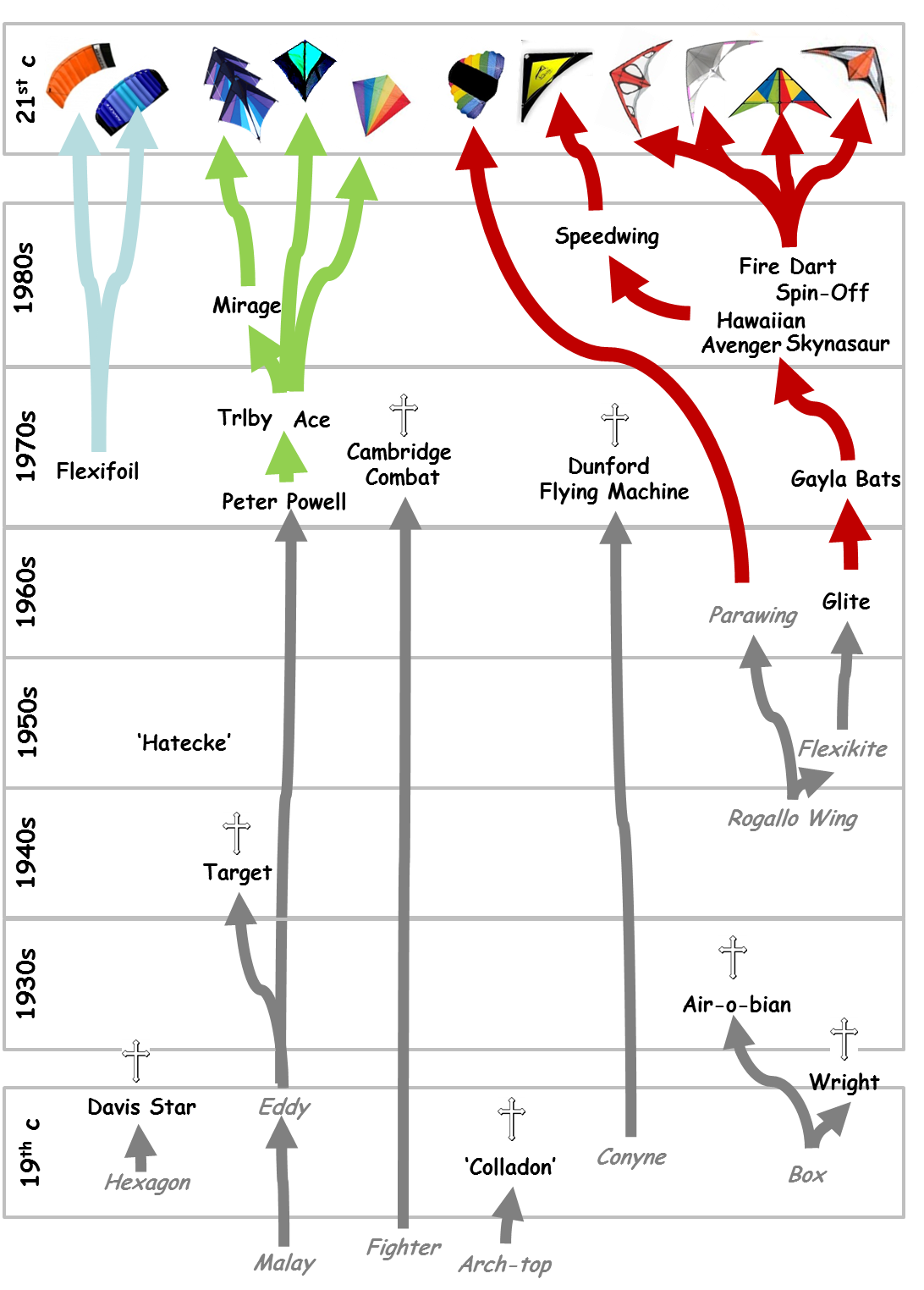
It won't be a surprise to those of you who have read most of my blog posts, that, besides flying kites, I'm also interested in the history of kites and kite-flying. One aspect of kite history I'm especially interested in is the origin and spread of dual-line kites. As I'm an evolutionary biologist in real life, it's second nature for me to 'see' evolutionary trees, so I've put together the information I've collected so far on early dual-line kites in such an 'evolutionary tree'.
Most of you will probably be familiar with the Peter Powell Stunter, which really popularised dual-line kite-flying in the early 1970s, but things were happening before that! For instance, the Rogallo Wing was invented in the 1940s, and the vast majority of present-day dual-line sport kites can be traced back to this kite. The 1940s also saw the Target kites, invented and designed by Paul Garber. And in the 1930s, a rather strange dual-line box kite, called the Air-o-bian, briefly caused a sensation. Going even further back in time, the late 19th century saw several rescue kites, controlled by two lines.
Because of my interest in these early dual-line kites, I have built reconstructions of Francis Rogallo's Flexikite, and of J Woodbridge Davis' Rescue Star (more on that kite, including a video of it flying, here):
For the new year, I am going to keep my eyes open for early dual-line kites, and especially for those which could be flown in a pair routine. I already talked about my project to build a pair of Target kites, and about trying to find a second Dunford Flying Machine. Two Trlby triple stacks would also work great in a pair routine, and how about a pair of Gayla Baby Bats, converted to dual-line flying as suggested by Richard Radcliffe in 1978? Also, I wouldn't say no to a pair of Cambridge Combat kites, or even to a single one.
We'll see how far I get in this; watch this space in 2013!